

A note on prices: Every price in this article was checked on October 20, 2026 and is used as an example to show how the range steps up. Promotions change often, and prices can be different by the time you read this. Always use the links in this article to check the current price and configuration before you decide. Check current LAUNCH X-431 prices →
LAUNCH has managed to create an unusual problem for mechanics. The scanners are often very good. Choosing one is not.
Open the current X-431 catalog and you will find the CRP919X BT, PROS Elite, PROS V5.0, V+ 5.0, PRO3 V+ Elite, PRO5, PAD VII and several overlapping models in between. Many advertise the same attractive phrases: full-system diagnostics, active tests, coding, CAN FD, DoIP and dozens of service functions. Yet the example prices run from about $439 to more than $2,000.
So what are you actually buying as you move up the range?
We went through the current catalog of an authorized LAUNCH dealer, compared the important models, read independent mechanic discussions and set the results beside current Autel and TOPDON alternatives. The conclusion is more useful than “buy the most expensive scanner.” For many independent mechanics, the interesting part of the LAUNCH range is between roughly $500 and $1,200.
The range that actually matters
| Model | Example price (Oct 20, 2026) | What changes |
|---|---|---|
| CRP919X BT | $439 | Wireless full-system diagnostics and bidirectional control |
| PROS Elite | $549 | More workshop-oriented package and online coding |
| V+ 5.0 PRO3 | $909 | Larger screen, topology and broader professional workflow |
| PRO3 V+ Elite | $1,019 | Adds SmartLink C and J2534 pass-through |
| PRO5 | $1,199 | Stronger professional programming platform |
| PAD VII Elite | about $2,150 | Flagship hardware and deeper programming ecosystem |
The dealer identifies itself as an authorized LAUNCH seller, and most of these models include two years of software updates. The table shows something the marketing pages don’t: the biggest buying decision isn’t between $439 and $2,150. It’s deciding which capability threshold your work actually requires.
At the time of checking, the seller was also advertising an additional 6% storewide discount at checkout. I have not included temporary checkout discounts in the example prices below.
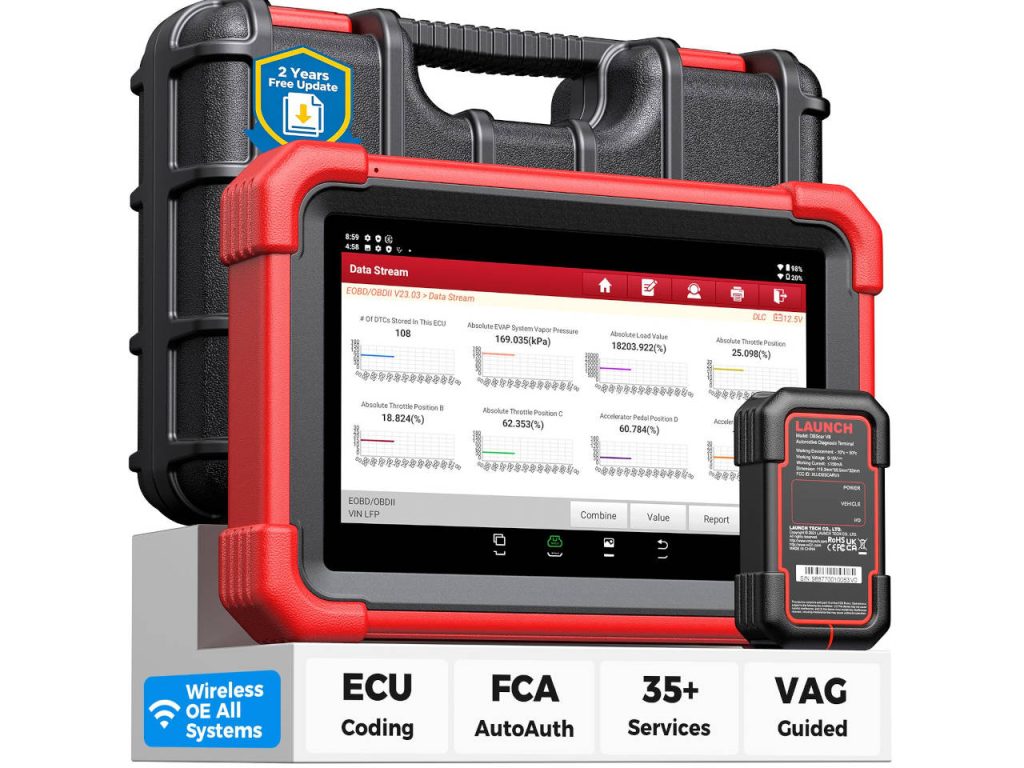
$439: CRP919X BT — already enough for a lot of real repairs
The CRP919X BT may be the most important product in the range, because it shows how much professional functionality has moved downmarket. It is not a glorified check-engine-light reader. The current model provides full-system diagnostics, wireless communication, active bidirectional testing, ECU coding on supported vehicles, CAN FD, DoIP and more than 30 service functions.
That means you can do far more than read codes. You can command supported components, watch the response and decide whether the problem is the component, the wiring, the control circuit or something upstream.
One owner described using a PRO5 to command a Chevrolet throttle body open and closed while watching live data. The actuator and throttle-position data behaved normally, which pointed the diagnosis at wiring instead of an unnecessary throttle-body replacement. It was a different model, but it’s exactly why active testing matters.
The CRP919X BT also has one advantage you’ll feel in a real bay: you’re not tied to the driver’s seat by a cable. For a mobile mechanic, a serious DIY user or an individual technician buying their own scanner, this is close to the level where a tool starts earning money rather than just saving it.
Its closest Autel rivals are in the same neighborhood: the MaxiCheck MX900 at about $559 and the wireless MK900-BT at about $659 (also example prices). Autel offers a polished interface, strong service coverage and very good vehicle support, but LAUNCH is noticeably cheaper at this level.
$549: PROS Elite — probably the best-value LAUNCH for a working mechanic
For about $110 more, the PROS Elite becomes very difficult to ignore. It’s listed with full-system diagnostics, extensive bidirectional controls, online coding on supported vehicles, CAN FD, DoIP, guided functions for VAG vehicles and two years of updates.
This is where LAUNCH starts making the most sense for an independent technician. The important difference isn’t a headline number like “1,000+ active tests.” It’s that the PROS Elite is designed around workshop use rather than occasional diagnosis.
One owner running a mobile-mechanic business praised the responsive live data, the bidirectional controls and maintenance procedures such as ABS bleeding, EPB work, steering-angle calibration and battery registration. Another was positive overall but said the interface can feel slow at times and that screenshots are awkward to retrieve.
That’s more useful than another feature table. The scanner appears capable. The software still has rough edges. That pattern comes up again and again with LAUNCH.
$700–$900: where the lineup gets confusing
This is where we wouldn’t assume that spending more buys a dramatically better scanner. The PROS V5.0 sits around $709, the PRO DYNO around $799 and the V+ 5.0 PRO3 around $909. All offer full-system diagnostics, active testing and increasingly advanced coding and service functions.
The most interesting of the group is the V+ 5.0 PRO3. At about $909 you move to a 10.1-inch professional tablet and gain topology mapping, CAN FD, DoIP, online coding, guided functions and broader service capability.
Why topology matters
Topology sounds like marketing until you diagnose a modern network fault. Instead of a flat list of modules, you see the vehicle’s electronic architecture as a map. If several modules suddenly report communication faults, that map helps you tell whether you’re chasing five separate problems or one network problem affecting five controllers.
It won’t diagnose the car for you, but it can shorten the path. For mechanics who spend most of their time on newer vehicles, we’d value topology more than another ten reset functions.
$1,019: PRO3 V+ Elite — the point where J2534 arrives
For that difference you get the SmartLink C interface and J2534 pass-through capability, while keeping topology, coding, bidirectional diagnostics, CAN FD and DoIP support (an adapter may be required for some DoIP applications). The tablet is a 10.1-inch Android unit with 4GB RAM and 64GB storage.
For a repair shop, that matters more than adding another list of maintenance resets. But J2534 needs explaining, because scanner advertising makes it sound simpler than it is. J2534 means the interface can work as a pass-through device with compatible manufacturer software. It does not mean unlimited free dealer programming. You may still need:
- The manufacturer’s software
- An OEM subscription and credentials
- A Windows PC
- A stable power supply for the vehicle
- The correct procedure for that specific car
The scanner provides the communication bridge. It doesn’t replace the manufacturer’s infrastructure. For a shop that never programs modules, the extra capability may sit unused. For a shop that regularly sends programming jobs elsewhere, it can start changing the economics of the tool.
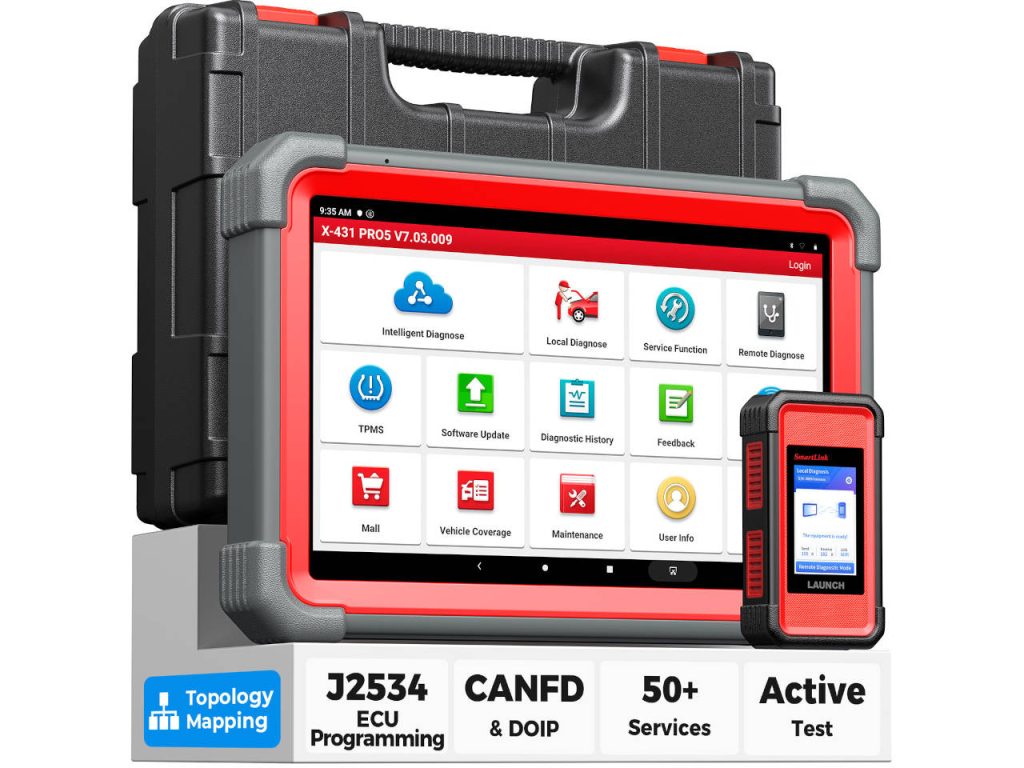
$1,199: PRO5 — this is where to stop and think
The PRO5 is about $1,199 with SmartLink C 2.0. It provides J2534, topology, online coding, bidirectional control, full-system diagnostics and more than 60 service and reset functions. The tablet is still modest by current standards (10.1 inches, 4GB RAM, 64GB storage), but the point of the PRO5 isn’t tablet horsepower. It’s the diagnostic ecosystem around SmartLink.
Independent feedback is encouraging, particularly for European work. In a recent mechanic discussion, a PRO5 user said BMW and Audi coverage was solid and that guided functions for DPF work and adaptations performed well. The main criticism from the same thread was the cost of software subscriptions.
The PRO5 isn’t compelling because it has a prettier screen than the PRO3 V+ Elite. It’s compelling if your shop will actually use its programming, topology and remote-diagnostic capabilities. At only about $180 above the PRO3 V+ Elite, we’d lean toward the PRO5 for a professional workshop if both are available at these prices. The gap is small enough that workflow, not saving the last $180, should drive the decision.
Compare current LAUNCH X-431 models →
$2,150: PAD VII — now you’re buying hardware as well as software
The jump to the PAD VII Elite is different. At about $2,150 during the current promotion, the hardware finally changes dramatically: a 13.3-inch display, octa-core processor, 8GB RAM, 256GB storage and SmartLink C.
It also adds the broader flagship ecosystem: J2534, D-PDU, RP1210, topology mapping, advanced coding and programming, optional heavy-duty capability and support for additional LAUNCH modules such as the X-PROG3, scope, SensorBox and TPMS equipment.
This isn’t simply a better PRO5. It’s a workstation. The larger display matters if you spend hours in topology maps, live-data graphs and diagnostic reports. The extra memory matters when the tool carries large vehicle databases. The processing power matters when the scanner is used all day rather than occasionally.
One detail deserves caution. The seller advertises online programming for a wide range of applications, but its own product page also notes that some programming functions depend on external OEM software, subscriptions and even regional access requirements. That’s exactly why we’d never buy a $2,000 scanner on the phrase “ECU programming.” Confirm the exact year, make, model and module you expect to program first.
At $2,000+, the competition changes
At the lower end, LAUNCH competes with Autel and TOPDON mostly on price and feature coverage. At $2,000 and up, the comparison gets more serious (all prices below are examples from the same date):
| Scanner | Example price | Highlights |
|---|---|---|
| LAUNCH PAD VII Elite | about $2,150 | 13.3-inch display, J2534, D-PDU, RP1210, topology, expansion modules |
| TOPDON Phoenix Smart | about $2,300 | Topology, J2534, CAN FD, DoIP, guided functions, cloud programming for supported brands; two years of updates, then about $795 per year |
| Autel MS908S Pro II | about $2,169 | J2534 ECU programming, bidirectional diagnostics, broad service functionality |
At roughly $2,150, the PAD VII competes directly with serious professional systems instead of sitting alone at an extreme price. Autel still holds an important advantage higher up its range: models such as the MS919 integrate an oscilloscope, multimeter, waveform generator and CAN-bus testing into the VCMI interface. If electrical diagnosis is a big part of your business, that matters. LAUNCH can add scope hardware, but it isn’t as integrated.
What mechanics say about LAUNCH versus Autel and TOPDON

Here the discussion gets less tidy than manufacturer marketing.
One technician who sells both LAUNCH and Autel estimated that the two perform roughly 95% of the same work, each occasionally handling a vehicle or function the other doesn’t. He rated LAUNCH as particularly competitive for topology and live data, and gave Autel the edge in update speed, long-term support and advanced shop-oriented functions. (He sells both brands, so treat the percentage as a rough impression, not a measurement.) Another mechanic who had used both preferred Autel’s communication and connection behavior, though his LAUNCH experience was several years old.
Mechanics in these discussions keep returning to one question: what cars do you actually work on? That matters more than the logo. A scanner can look fantastic on BMW and Audi and still frustrate you on the one domestic platform that pays your bills. A working technician in another thread recommended LAUNCH’s 8- and 10-inch scanners as more than sufficient for a personal professional tool without tool-truck prices.
That’s probably the fairest summary: strong capability for the money, very broad coverage, not universal.
Don’t rely too heavily on the seller’s star ratings
The dealer shows hundreds of positive reviews on many models. The CRP919X BT, for example, shows more than 400, and the PRO5 around 250. They’re worth reading for recurring owner experiences, but they aren’t an independent reliability study. Some reviews are labeled as collected from another provider, and some older review text on certain product pages doesn’t clearly match the exact tool being sold.
That’s why we put more weight on patterns across independent mechanic discussions:
- Recurring positives: good value, broad coverage, useful active tests, strong European and Asian capability, smooth live data.
- Recurring negatives: occasional software roughness, functions that vary by vehicle, uncertainty around regional support, and the cost of keeping professional tools fully updated.
That’s a more realistic picture than a 4.9-star average.
The hidden cost is updates
The first two years are easy, because many current packages include two years of free software updates. After that, cost depends on the model. The dealer currently lists (as examples) about $165 for one year of updates on the CRP919X BT / PROS Elite family, about $350 for the V+ / PROS V family, about $350 for the PRO5 and about $449 for the PAD VII.
That changes the ownership math. A PRO5 plus several years of updates is still far cheaper than some traditional professional platforms, but it isn’t a one-time purchase if you expect current coverage indefinitely. TOPDON works the same way: its Phoenix Lite 3 renews at about $495 per year, while Phoenix Smart and Max renew at about $795. Autel also sells ongoing update plans.
Professional diagnostic software is effectively a continuing operating cost. So the right question isn’t “how much does the scanner cost today?” It’s: how much will I spend keeping it useful for five years, and how much work will it let me keep in-house over those five years?
Which LAUNCH would we buy?
| If you are… | Look at | Why |
|---|---|---|
| A serious home mechanic or technician who mainly needs full-system diagnostics and active tests | CRP919X BT (about $439) | Hard to beat for the money |
| An independent mechanic buying an everyday tool | PROS Elite (about $549) | Probably the strongest value in the lineup |
| A shop that wants topology and a bigger interface but not J2534 | V+ 5.0 PRO3 (about $909) | Topology without paying for programming hardware |
| A shop planning to take on programming work | PRO3 V+ Elite (about $1,019) or PRO5 (about $1,199) | J2534 arrives here; with a small gap, we’d stretch to the PRO5 |
| A high-volume shop where hardware speed has real value | PAD VII Elite (about $2,150) | Only if the larger hardware and expansion ecosystem will make money |
The PAD VII is worth buying when its advanced programming workflow will pay for itself. Not because it’s the flagship.
One buying mistake to avoid
Before ordering any LAUNCH scanner, verify the exact function you need on the exact vehicle you service. The dealer itself provides a compatibility checker and tells buyers to confirm make, model, year and required function before purchase. That matters more than any headline specification:
- “ECU coding” doesn’t mean identical coding support across every manufacturer.
- “Key programming” doesn’t mean every key.
- “J2534” doesn’t mean free OEM software.
- “60+ service functions” doesn’t mean all sixty work on the car in front of you.
A scanner can advertise thousands of functions and still be the wrong tool because it can’t perform the one adaptation waiting in your bay tomorrow morning.
The bottom line
At these example prices, you can get genuine bidirectional full-system capability from roughly $439, strong professional workshop functionality at around $550, topology for under $1,000 and J2534 hardware from roughly $1,000 upward. That changes the comparison completely.
For most independent mechanics, the sweet spot is somewhere between the PROS Elite and the PRO5. The lower model gives you enough capability to diagnose and verify a large share of everyday repair work. The higher one gives a shop room to grow into programming and deeper module work.
Beyond that, the question stops being “which scanner has the most functions?” It becomes: which jobs do I currently send away because my scanner can’t do them? That’s the number that should decide how much you spend.
And remember: the prices here are examples as of October 20, 2026. Check the live price and what’s included before you buy.