
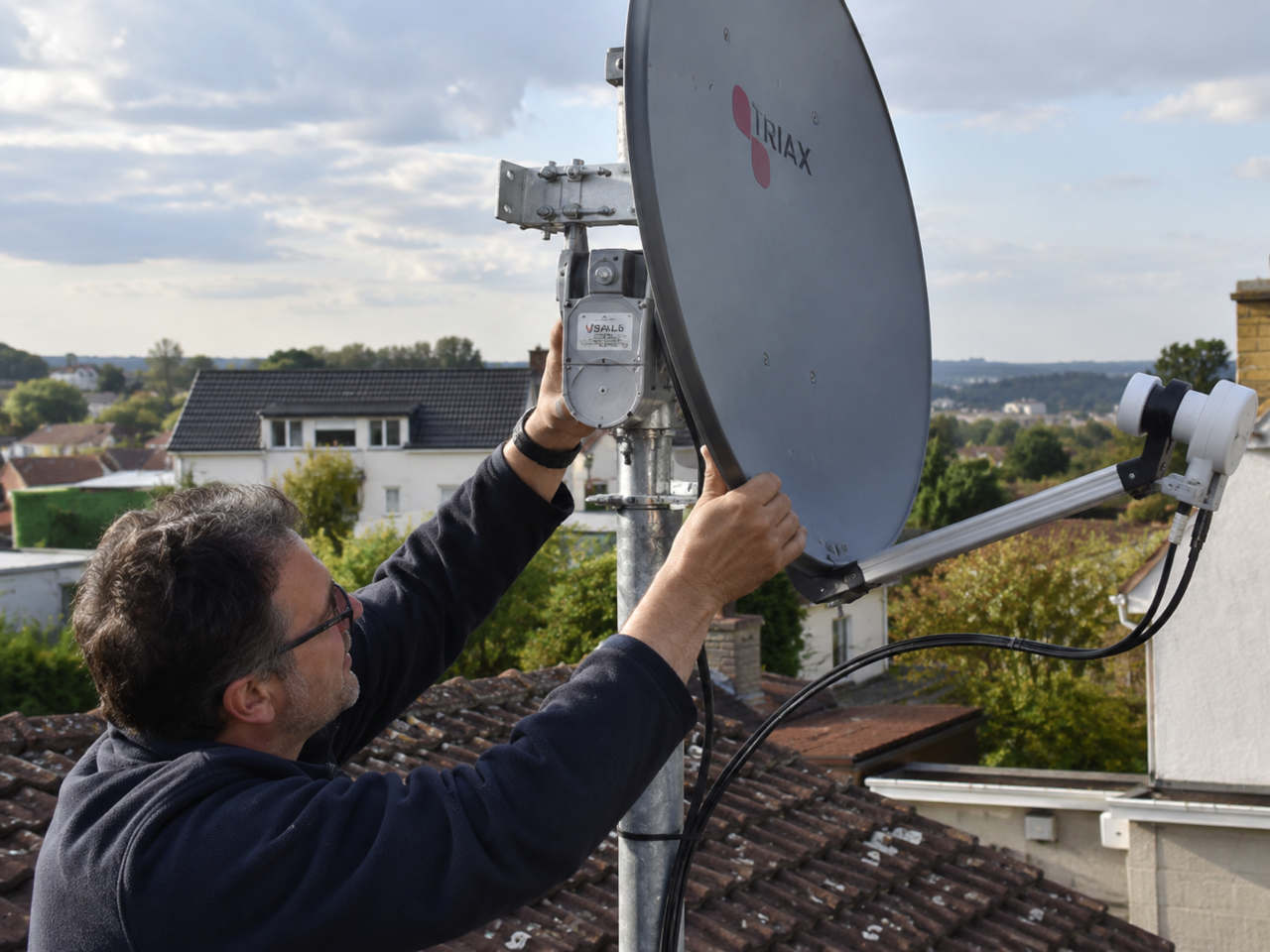
When people first attempt to install a motorized satellite dish, one piece of advice appears almost everywhere:
Make sure the pole is perfectly vertical.
It is good advice—but taken too literally, it can also make the job seem much more difficult than it really is.
A motorized dish is a geometric system. Several adjustments interact with one another, and small errors in one place can often be compensated for elsewhere.
That is one of the ideas I tried to explain in plain language in my book, How a Newbie Can Set Up a Motorized Satellite Dish.
The following is a short excerpt from the guide.
From the book: “The ‘Fifth’ Angle Doesn’t Matter”
Let’s talk about the angles. First, the common claim that “the pole/mount must be perfectly vertical” is only true if all other angles are exactly correct and you are not going to fine-tune the system. In practice, this is almost impossible.
The tilt of the pole toward north or south is compensated by adjusting angle “A”.
The tilt of the pole toward east or west is compensated by rotating the entire motor on the pole (angle “C”).
If the pole is heavily tilted east or west, compensation with “C” will reduce the maximum rotation range in the opposite direction.
Conclusion: “vertical by eye” is perfectly sufficient.
The guide then reduces the alignment problem to four practical adjustments.
Angle A is the tilt of the motor’s polar axis. It is roughly equal to 90 degrees minus your latitude.
Angle C is set by rotating the motor on the pole and determines the basic azimuth.
Angle B is the dish-elevation adjustment used during final arc alignment.
And position D is the rotation of the dish on the motor shaft, which helps correct the direction of the dish when the motor is at its zero position.
Why I think this matters
The point is not that the mounting pole can be installed carelessly.
It still needs to be rigid, reasonably vertical and strong enough to handle the additional leverage created by a dish and motor.
The useful distinction is between “reasonably vertical” and spending excessive time trying to make the pole mathematically perfect.
The final alignment is determined by how accurately the dish follows the geostationary satellite arc.
That is why the full procedure in the book does not stop after finding one satellite. It uses a reference satellite close to due south and then compares reception on satellites to the east and west. The way signal quality changes when the dish is moved slightly up or down tells you which part of the geometry needs correction.
That is also the reason a motorized system can appear perfectly aligned at one orbital position and still perform badly elsewhere.
You are not really aligning the dish to one satellite.
You are aligning the entire mechanical arc.
About the guide
I wrote How a Newbie Can Set Up a Motorized Satellite Dish for people who already understand the basics of aligning a fixed satellite dish but have never installed a motorized system.
I deliberately kept most of the mathematics and specialist terminology out of it. The guide starts with the basic geometry of geostationary satellites and true south, then moves through motor setup, USALS, reference-satellite alignment and finally the east/west corrections needed to make the dish track the complete arc.
The full guide also includes diagrams showing what happens when the dish’s mechanical arc is shifted east or west, or when the polar-axis angle is too large.
If you are setting up your first motorized dish and want the complete procedure rather than isolated adjustment tips, the full guide is available on Amazon.