
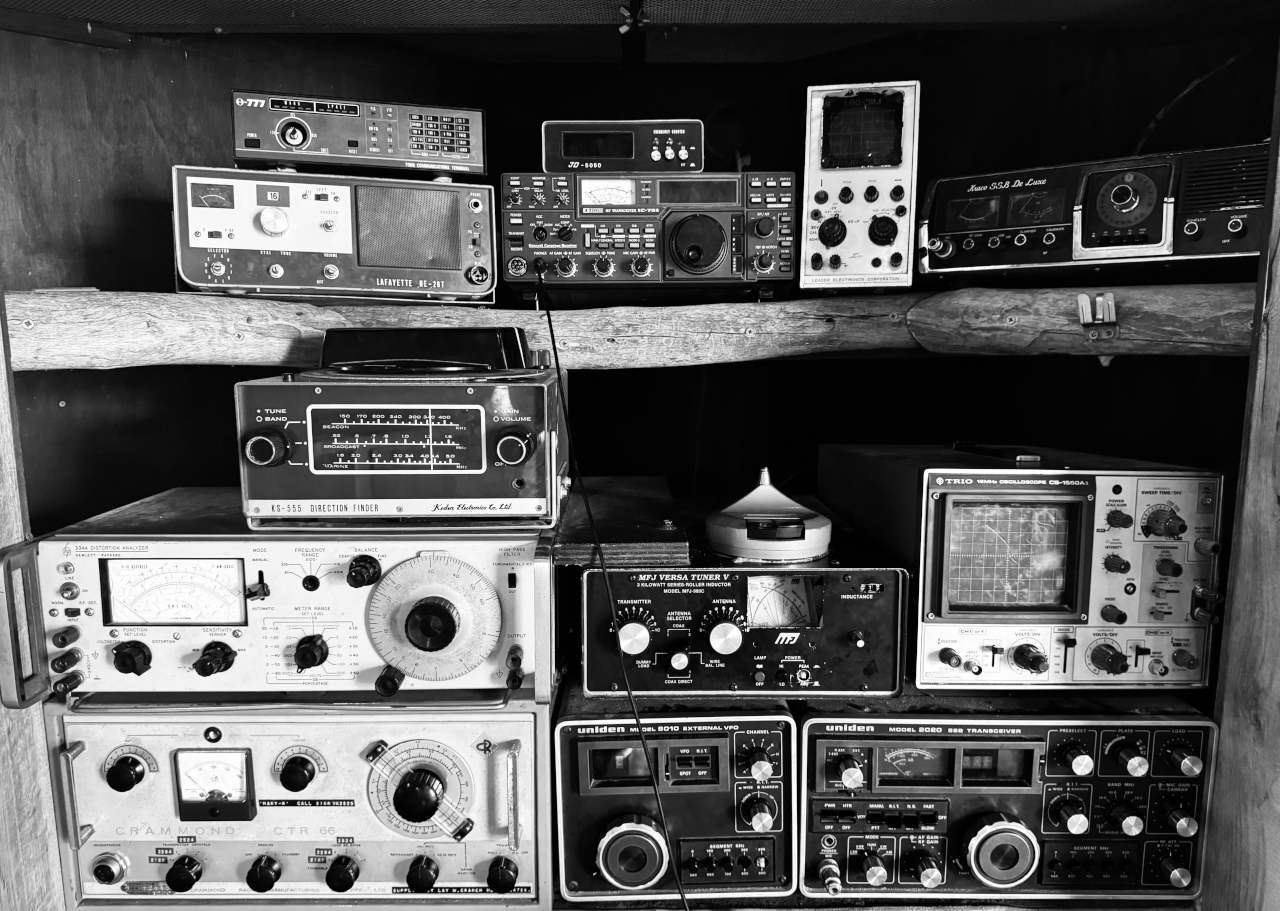
There’s a particular kind of magic in ham radio. You switch on a radio, turn a dial through a hiss of static, and suddenly a stranger in Japan or Chile or Finland is saying your callsign back to you. No internet, no phone network, no app. Just a wire in the air, a bit of physics, and a person on the other end who’s as delighted as you are.
People have been doing this for over a century. Some chase far-off contacts on the shortwave bands, some talk through satellites, and some even reach astronauts on the International Space Station. Others like to build their own antennas, join weekend contests, or help with communications when storms knock out everything else. It’s a hobby that’s equal parts technical, social and plain fun, and it’s still growing.
If you want to join in, getting licensed is the first step. And if you travel a lot, live abroad, or hold more than one passport, an American license looks like a tempting way in. The exams are in English, some can be taken online, and you don’t have to be American to sit them.
So can you pass the exam from your kitchen table, collect your FCC callsign, and start transmitting wherever you happen to be?
Not quite. Getting the license is one thing. Being allowed to use it in another country is another, and the answer depends on where you’re going, which license you hold, and what passport you carry.
You don’t have to live in America to hold a US license
The Federal Communications Commission (FCC) issues amateur licenses under Part 97 of its rules. Unlike many countries, the US doesn’t generally require applicants to be citizens or residents, and the American Radio Relay League (ARRL) confirms that foreign nationals can apply.
There is some paperwork. You’ll need an FCC Registration Number (FRN), and you must meet the eligibility rules. Representatives of foreign governments are generally not eligible.
There are three license classes:
- Technician: 35 questions. Wide access to VHF and UHF, plus limited HF privileges.
- General: 35 questions. Much broader HF access.
- Amateur Extra: 50 questions. Every amateur frequency privilege the US grants an individual.
The exams build on each other, so a newcomer aiming for Amateur Extra must pass all three. If the exam team allows it, you can do all three in one sitting. There’s no Morse code test.
If you plan to operate abroad, Extra is worth considering. Some reciprocal arrangements recognize the higher US classes but not Technician. Even so, it isn’t an international license.
Taking the exam online
Yes, you can. Authorized Volunteer Examiner teams run remote sessions, and the ARRL keeps a directory of teams that offer them. You register, verify your identity, and take a supervised test over video.
Teams set their own rules about cameras, computers, room setup and, sometimes, where candidates are located. If you’re outside the US, confirm that a team will accept you before you book.
Once you pass and the FCC grants the license, you have a US callsign. That callsign is a US authorization, though, and every country regulates transmissions made on its own soil.
Why an FCC license isn’t a passport
Radio waves ignore borders, but regulators don’t. An FCC license says you’re authorized under American rules. It doesn’t, on its own, let you transmit from France, Georgia, Japan or Israel.
Operating abroad generally comes down to one of three routes:
- Reciprocal arrangements, where countries agree to recognize each other’s licenses for temporary operation.
- Individual permission, where the local regulator issues a temporary permit.
- Local licensing, where the foreign qualification is recognized or converted into a domestic license, sometimes with extra requirements.
For a holiday visit, that’s a manageable puzzle. For someone moving between countries, it matters a lot more.
The CEPT catch: citizenship
Europe’s best-known arrangement is CEPT (European Conference of Postal and Telecommunications Administrations) Recommendation T/R 61-01. Under it, eligible amateurs can operate temporarily in participating countries without applying for a license each time. The US takes part as a non-CEPT administration, and qualifying US license classes get reciprocal privileges.
The catch is that the ARRL says US operators using this arrangement must be US citizens. So two people can pass the same exams and hold the same Amateur Extra license, and only one of them may enjoy CEPT privileges. The non-citizen may need separate authorization.
There’s a second limit. The US doesn’t take part in CEPT’s HAREC arrangement (T/R 61-02), so an FCC license can’t be treated as a HAREC (Harmonised Amateur Radio Examination Certificate) certificate and automatically converted into a permanent European license. A country can still choose to recognize it under its own national rules, but CEPT doesn’t guarantee it.
Georgia: a friendly answer, with a question mark
Georgia is a good example because it treats short stays and permanent callsigns differently.
In October 2026 I wrote to the Georgian Communications Commission. Their reply was that foreign amateurs may be able to operate temporarily on their existing callsign with the Georgian prefix. The period they described was three months, with the possibility of asking for an extension. A permanent Georgian callsign would require passing a local exam.
Georgia’s published regulatory decisions point the same way. They describe temporary operation for amateurs from CEPT countries, using the prefix for up to three months, and set out procedures for longer stays.
What I couldn’t establish is whether the same treatment applies to any foreign FCC holder, and in particular to someone who is neither a US citizen nor from a CEPT country. The regulator’s reply was encouraging, but get written confirmation for your own license and citizenship before you key a microphone. And if you’re moving to Georgia rather than visiting, a temporary permission won’t solve your long-term licensing question.
Israel: promising for Israeli citizens
Israel’s Ministry of Communications runs a procedure for recognizing foreign amateur qualifications and issuing Israeli certificates. Under its published guidance, foreign certificates that meet the applicable CEPT requirements may be recognized, and those that don’t may require an Israeli exam. Israeli citizens converting a foreign qualification submit a copy of the certificate, ID, personal details, declarations and a passport photo.
In October 2026 I also asked the Israeli amateur radio licensing authority directly. The answer was that an Israeli citizen who obtains an American amateur license can be issued an Israeli one. For Israelis weighing an English-language FCC exam against the domestic route, that’s good news.
One question is still open: would the applicant still have to pass an exam in Israel, possibly in Hebrew? I’ve sent a follow-up and will update this article when I hear back. Until then, I wouldn’t claim that an FCC Extra license converts with no further testing. A regulator agreeing to recognize your license isn’t the same as waiving everything it normally asks for.
Canada and everywhere else
Canada is often held up as the easy case. The US and Canada have a long-standing reciprocal arrangement, and the ARRL explains that qualifying US amateurs can operate temporarily there, following Canadian operating and identification rules. But that guidance also calls for proof of US citizenship, so a non-US citizen with an FCC license shouldn’t assume it works the same way for them.
Elsewhere, the rules vary. Some countries offer reciprocal permits, some want individual authorization, and some require local licensing. I’m deliberately not publishing a country-by-country list, because it would mislead without knowing your license class, your citizenship, how long you’re staying, and what the rules say today. The ARRL’s guidance for US amateurs operating overseas is a good place to start, but the destination country’s regulator has the final say.
Five questions to ask before you travel
A short email to the regulator, before you travel or ship any equipment, can save you a lot of trouble:
- Does the country recognize my specific FCC license class?
- Is that recognition open to non-US citizens?
- Can I transmit temporarily with my FCC callsign, and with what prefix?
- Do I need a separate permit or a local exam for a longer stay?
- Which bands, power limits, equipment rules and identification requirements apply?
If you’re a permanent resident, add one more: can my American qualification be converted into a local license without another exam? As Georgia and Israel show, that can get a very different answer from a question about temporary operation.
Is Amateur Extra worth it if you live outside the US?
If you only ever plan to operate from one country, that country’s own license may be the simplest path. But the FCC route has real appeal. The system is clearly structured, study material is plentiful in English, and online testing helps people who can’t easily get to a local exam. Amateur Extra is a serious technical achievement and carries the broadest individual privileges the US offers.
Just don’t mistake those advantages for a right to transmit anywhere. If your goal is a license in a particular country, contact that country’s licensing authority before you spend months on the American exams. Ask whether the qualification is recognized, under which rules, and whether you’d have to sit anything else.
The bottom line
Anyone qualified can earn a US amateur license, whatever their nationality or address. In some cases it can even help you get licensed somewhere else. But the license, your citizenship, temporary reciprocal privileges and permanent local recognition are four separate questions, and the answer to one doesn’t settle the others.
My experience with Georgia and Israel shows why it’s worth asking regulators directly. General guidance is helpful, but it rarely tells you what happens in your particular case. An Amateur Extra license may open doors internationally. The real question is which ones it opens for you.
I’ll update this article as more regulators reply.